In a hurry and want the spreadsheet template right away? Click here.
Building on years of work, I’m pleased to release an Excel Checkbook Register template that is targeted for small business.
“I mistakenly thought that Excel would have a simple and easy to use checkbook register template. Not so! They offer one but it was extremely frustrating to use. However, your spreadsheets were extremely easy to use and I thank you very, very much for sharing your expertise!” (John J.)
System Requirements / Compatibility Notes: You must already have the Microsoft Excel program on a Mac or Windows PC. This Excel template is compatible with Excel 2021 or higher (Windows). It is not compatible with the free Excel online (web) version, nor Google sheets, LibreOffice, OpenOffice, or any other office clone. For Mac users, you will need Microsoft 365 in order for the dashboard to work as ‘power query’ is not available in older versions of Excel for the Mac. If needed, the latest version of Microsoft Office is available for $99.99/year (or $9.99/month) with the first month free, or as a one-time purchase (no subscription).
Tip to save money: Microsoft has a discount program that offers 30% off of Microsoft 365 for many employees, teachers and current/past military. Sept 2025: A favorite computer magazine website of mine just offered Microsoft Office 2021 (lifetime license) for a great price, if needed!
Summary of Features
- Manage up to 15 different bank accounts (checking, savings, credit cards)
Note: As of September 16, the spreadsheet now supports 15 register worksheets. - Easily categorize each entry to track spending by category
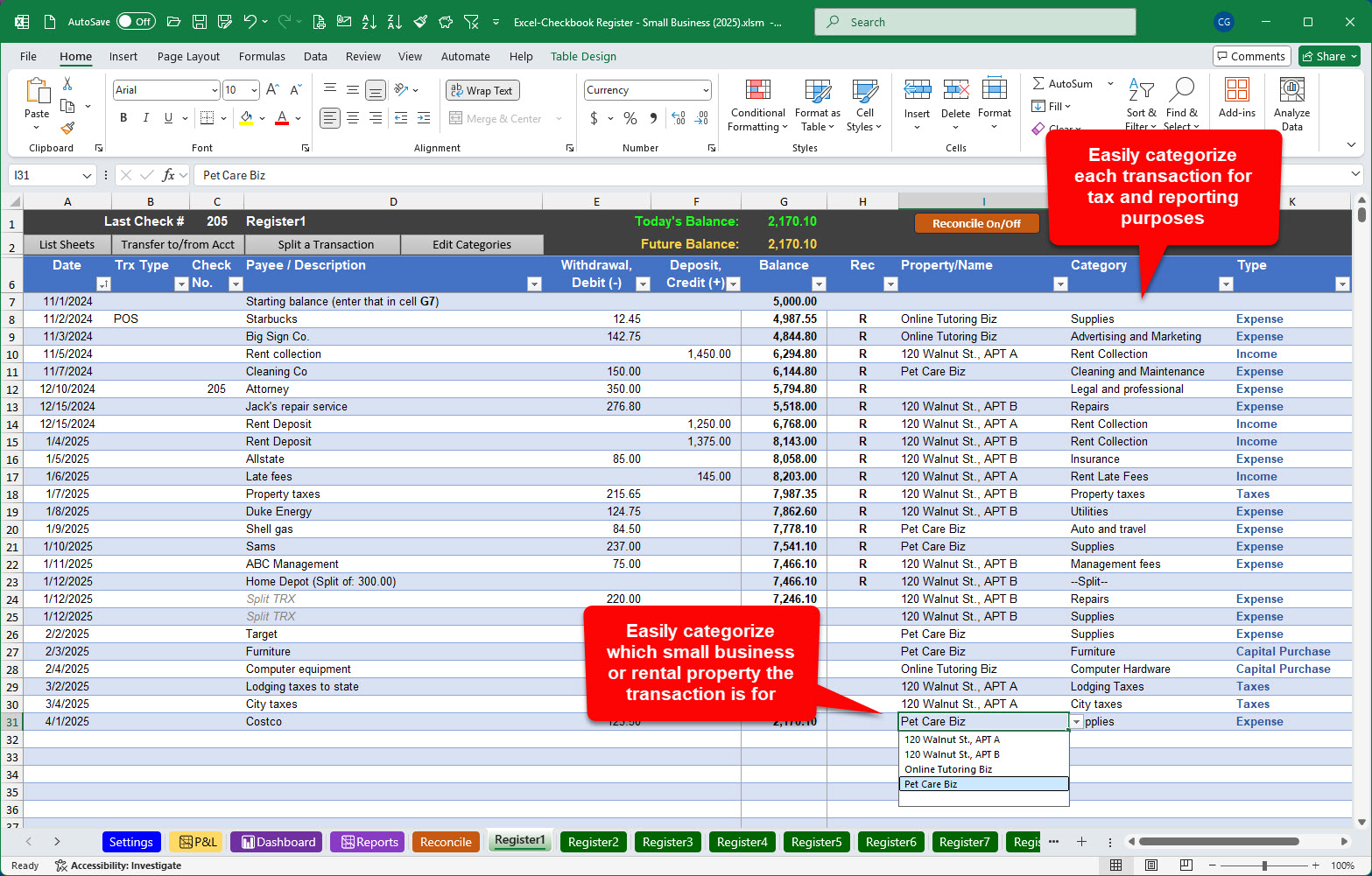
- Easily specify which business the transaction is for if you use one bank account for multiple businesses
- See a visual reminder at the top of each register with current balance, future balance, and last check number entered
- Enjoy two ways to reconcile your checkbook with your bank statement
- Gain the ability to quickly post recurring transactions and deposits to your register with a single click
- View your spending with a dashboard which displays charts for deposits & withdrawals by category and sub-category, with buttons to filter your data by year, month, register and/or category
- View your spending with a text-based report, suitable for printing, which also features convenient buttons (slicers) to filter your transactions by year, register, category, and business
- View a profit & loss statement with filter buttons to choose a specific year and/or business
- Accelerate data entry with convenient drop-downs for Date, Trx Type, as well as a drop-down list of frequent Payee/Descriptions which will auto-populate your preferred category when chosen
- Enter recurring future transactions quickly
- Split a transaction across multiple categories for better tracking of spending, especially helpful for large expenses and/or when a transaction should be split across your different businesses
- Enter a transfer transaction (e.g., a withdrawal from checking which deposits to savings) as a single entry to save time.
Up to 15 Registers
You can record transactions for fiftteen different bank accounts. Those can be any combination of checking, savings and/or credit card accounts — anything that has transactions with dates and dollar amounts.
Post Future Transactions with a One-Click Button
This feature makes it super quick to post your recurring transactions into your checkbook with a single button click. In other words, you can create a list of expenses that you have every month, and when you want to paste them into your register, you can click a button and all of them will get entered! These can also be separated into groups, in case you only want to post a subset early in the month and a different set when it’s later in the month. Note: a VBA macro is embedded in the template for this feature. Learn more about macros.
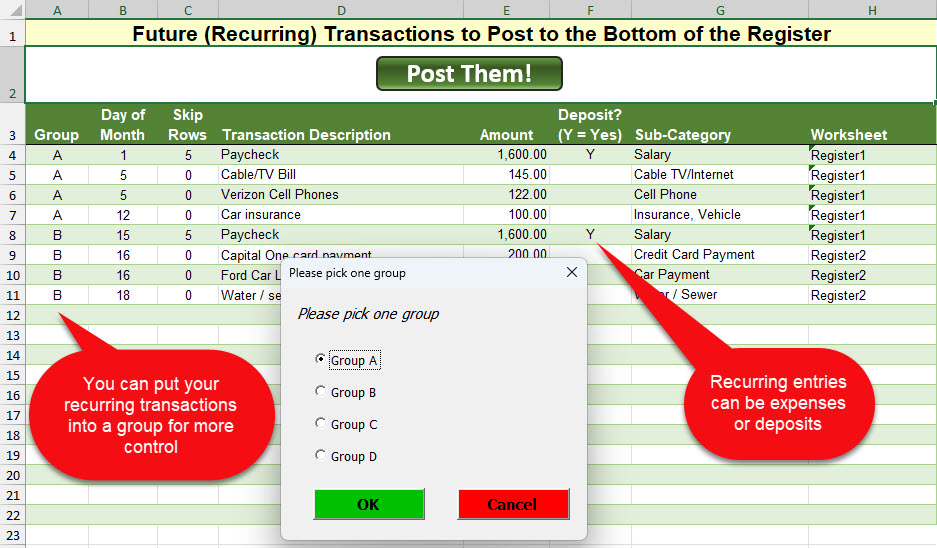
Why is this handy? I like to keep an eye on my bottom line. How much money will I have at the end of the month before I get paid again? By putting in those future expenses, it helps me see how much money I’ll likely have later in the month.
Split a Transaction
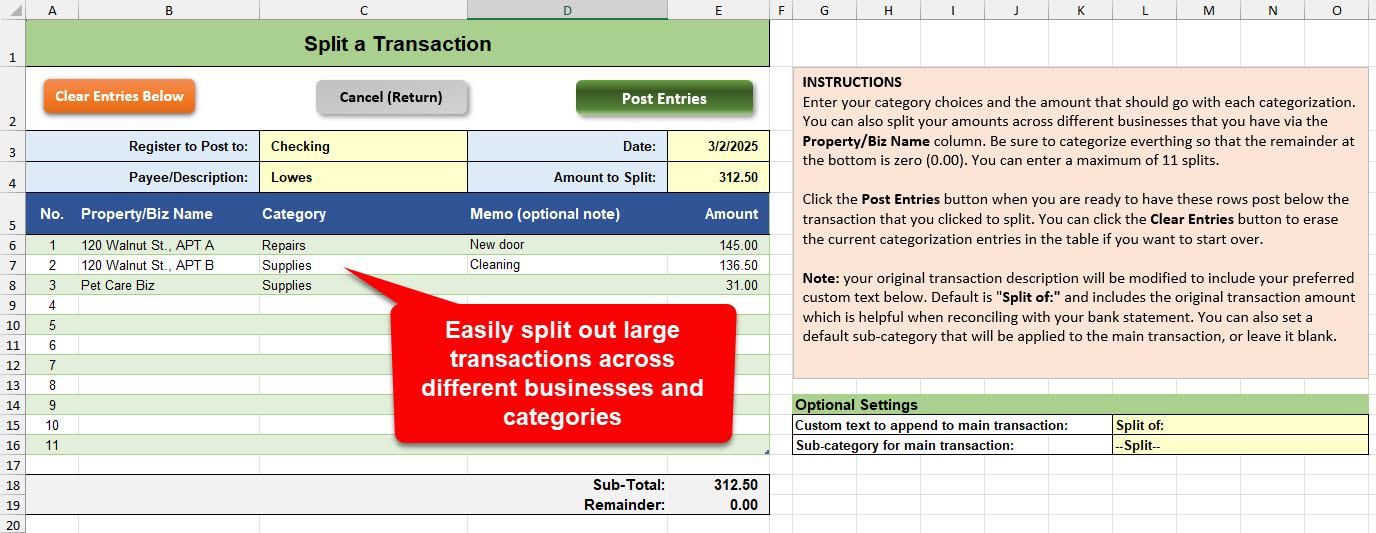
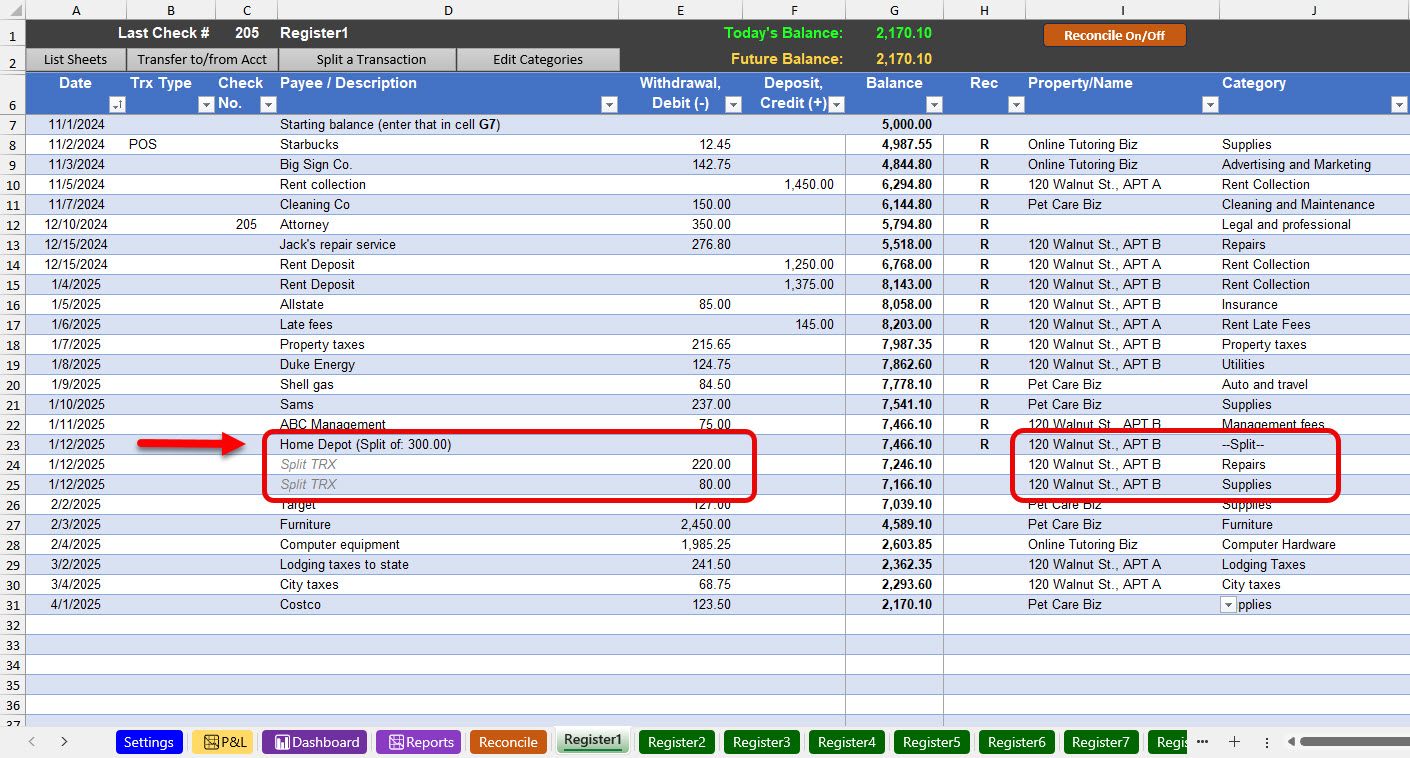
For larger expenses or deposits, you can click a button to split out the amounts into different categories for more accurate tracking of your expenses.
Enter a Transfer Between Two Accounts
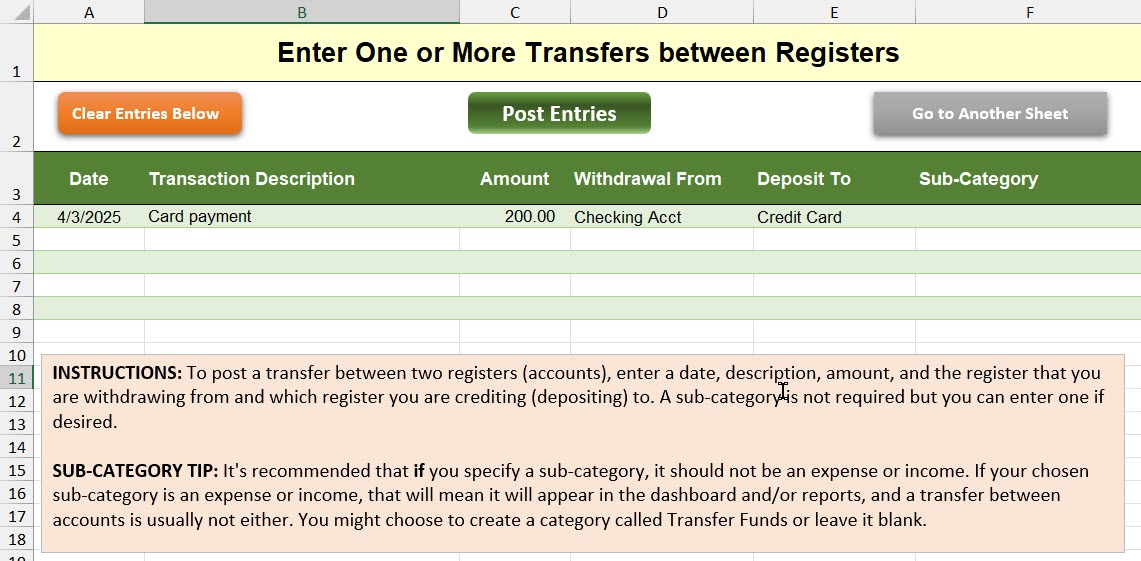
If you often move money between two accounts (e.g., from a checking account to a savings account), this feature accelerates the data entry so that you only have to enter one entry and it will create the corresponding entry in the other account.
Reconcile Transactions
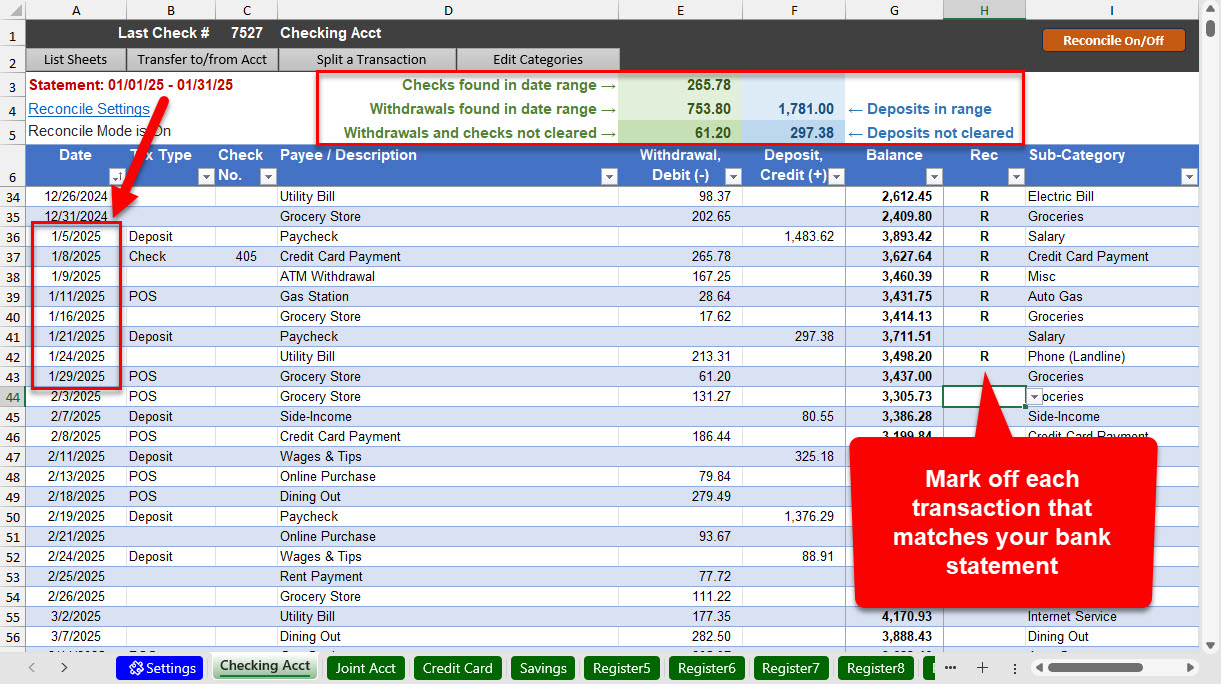
If you need to reconcile your transactions against your monthly bank statement, there are two different features to make that task easy. The first feature will show you the total dollar amount of withdrawals, deposits and checks that you have already entered into your spreadsheet for the date range specified. This is often all that is needed to confirm you have everything entered correctly.
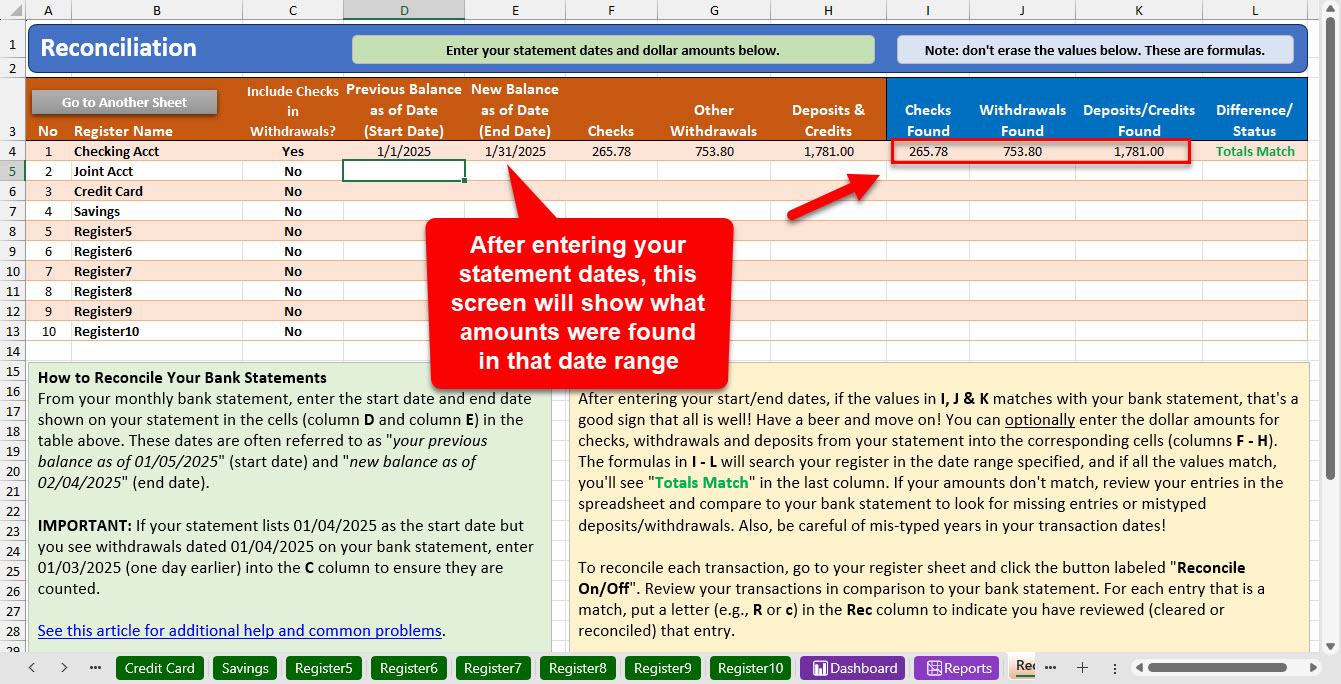
When needed, you can also review each transaction against your monthly bank statement. As you mark each one with an “R”, the screen will subtract each amount from the totals displayed.
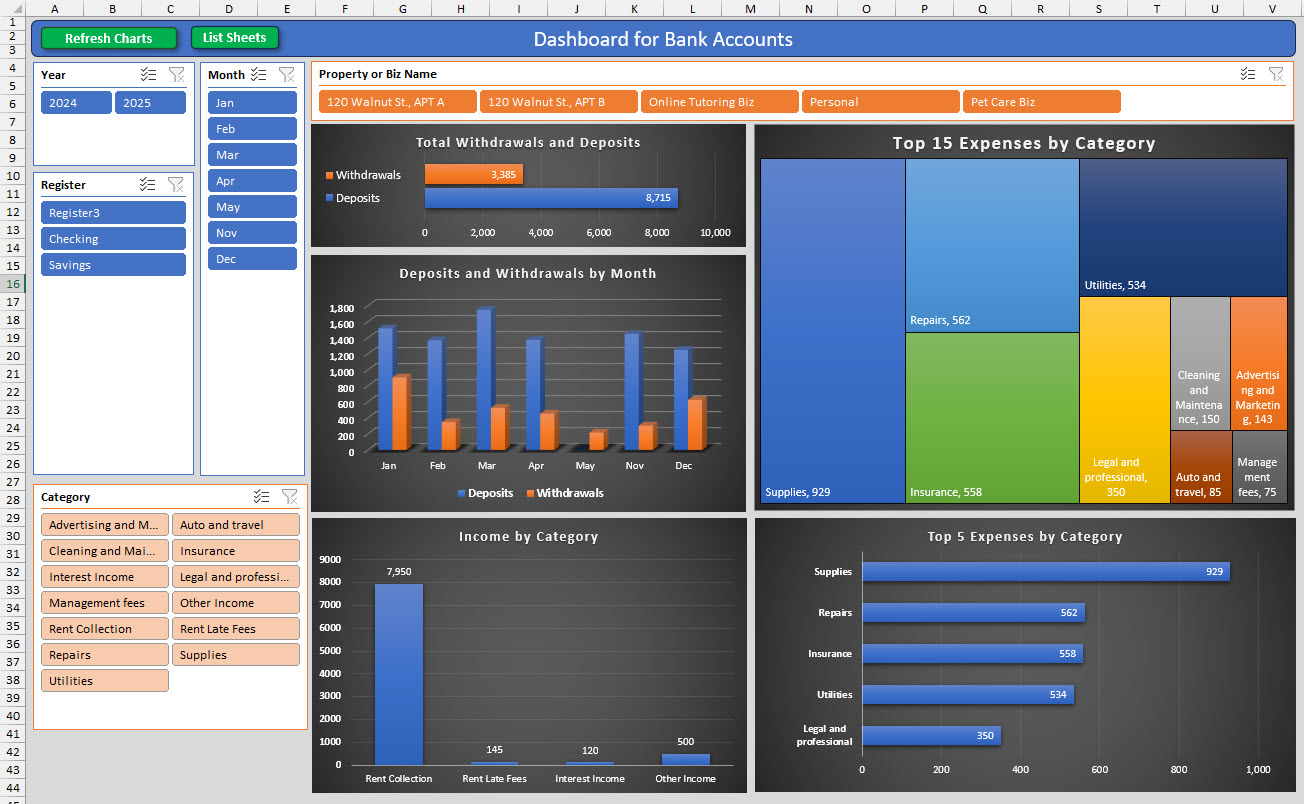
Financial Dashboard
The financial dashboard consolidates all of your bank accounts to a single dashboard. There are filter buttons to easily focus in on a particular year, month, category and/or to focus on a specific bank account and/or a specific business. Note: a VBA macro is embedded in the template for this feature. Learn more about macros.
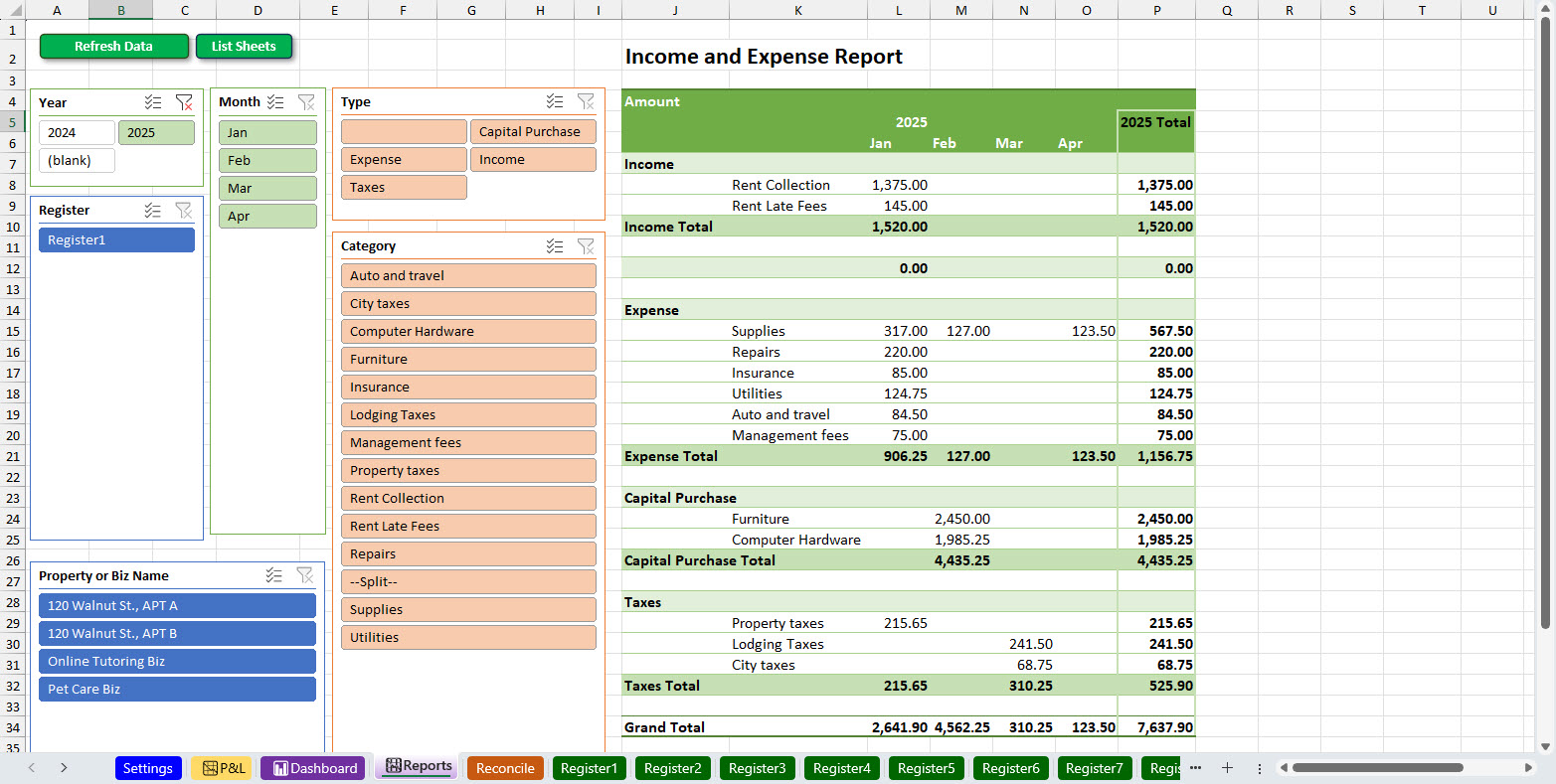
Financial Report/Statement
View a text-based report with filter buttons to see expenses and credits by year, month, category, bank account, and a specific business.
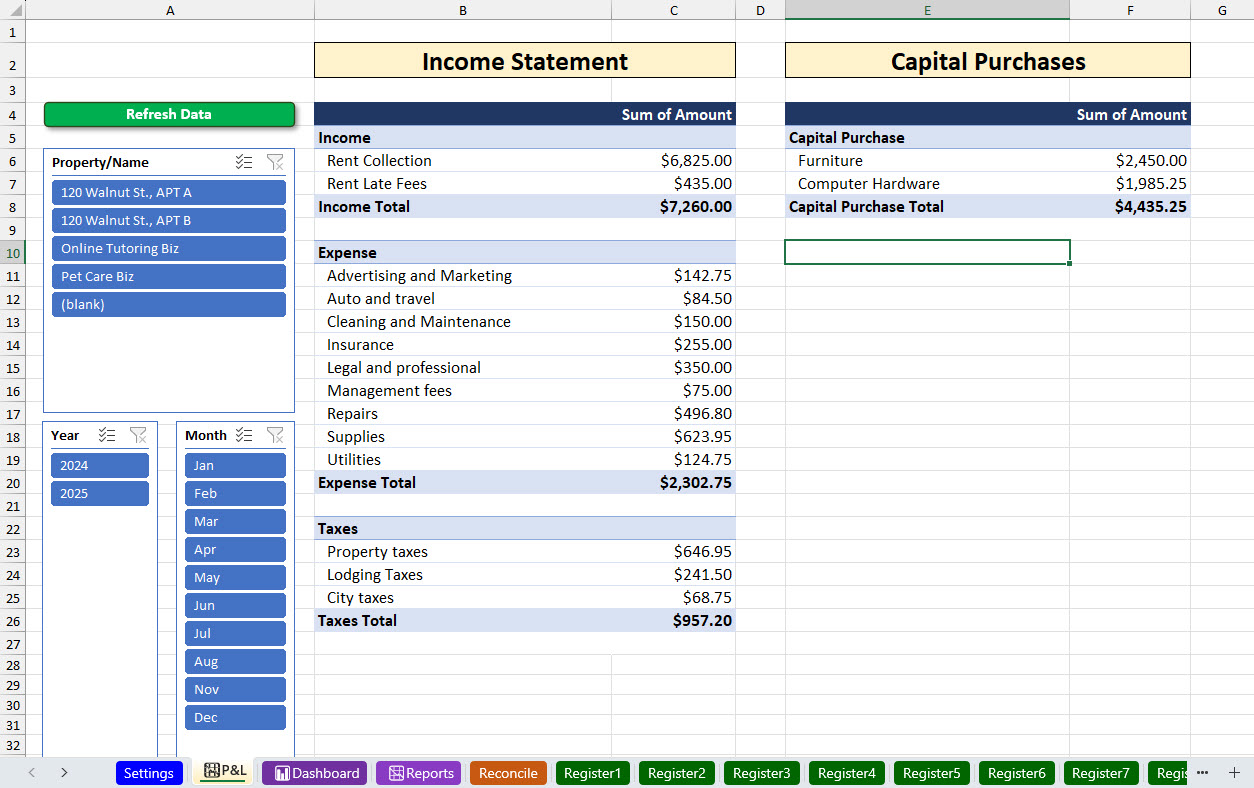
Profit & Loss Statement (P&L)
Easily view a profit and loss statement with options to see it by year, month and per small business.
Demonstration Video
- View this walk-through video on how to use the checkbook spreadsheet
Click the purchase button to download
I am enjoying the updated spreadsheet!
Excel Checkbook is very easy to use and manage all of your bank accounts. I am using this product to help my elderly father manage to plus accounts he has and it has been a life saver in keeping everything straight and balanced. I highly recommend this product as it is affordable and easy to use. Thank you Excel Checkbook!
### ⭐⭐⭐⭐⭐ Review for Excel-Checkbook.com
I couldn’t be more impressed with the XLS spreadsheet from **excel-checkbook.com**. It’s a fantastic value for anyone who wants a reliable, secure, and customizable way to balance checking accounts or generate insightful dashboards.
What sets this spreadsheet apart is that it keeps your financial data under your control. You don’t have to store anything in the cloud unless you choose to back it up there, which is a huge plus for privacy-conscious users.
Setup was refreshingly simple. Even those with only basic Excel skills will find it easy to get started. The pulldown menus are intuitive, and customizing categories or sub-categories takes just a few clicks. Within minutes, I had a tailored system that fit my personal budgeting style perfectly.
The dashboard features are especially powerful—clear visuals that make tracking spending and account balances effortless. It’s the kind of tool that combines simplicity with flexibility, giving you professional-level insights without the complexity or subscription fees of other financial software.
If you’re looking for a secure, easy-to-use, and highly customizable solution for managing your checking account, this spreadsheet is an outstanding choice.
Thank you Margaret!
I absolutely love the Excel Checkbook. I used Quickbooks for my home checking for years but it got far too expensive for that. So I searched far and wide for some app that would fit my needs and have a free or reasonable cost. Of course I found nothing suitable. Then I stumbled upon Excel Checkbook Register. I immediately knew it was perfect!
I’ve used Excel for years and knew of its simplicity, and it’s powerful capabilities. The formulas needed for a good home checking system are way above my ability. I’m so thankful this was accessible and for such a reasonable cost. Thanks so very much for making this available to me and people like me. It’s an answer to prayer.
This Excel Checkbook Register - 2025 is perfect for my needs and what I've been searching for to keep an electronic register. I am so impressed by the ease of use, the tabs, the clear directions, and all the accounting details I need. I previously used Quicken and generally liked it, but I wanted a stand-alone (offline) checkbook type of register for all my accounting and bank accounts. This is it!!
The best part about all this is Logan's excellent customer service when I had questions about how some of the functions worked. He has done a great job with his tutorial videos, FAQs and his own personal attention to my questions. What a difference a human makes!! Thank you again for a great product - keep up the good work!
A note about macros / security warning / how to fix
This Excel template is a macro-enabled file. If you use Microsoft Windows, please see this article for steps to follow.
Submit your review | |
Discover more from Excel Checkbook
Subscribe to get the latest posts sent to your email.
when you say manage up to 10 bank accounts… does that mean one can only make 10 register tabs on the sheet? or you can work with 10 bank accounts per register tab?
Hi, the current version supports up to 10 register tabs. While it is technically possible to add more register tabs (worksheets), it’s a fairly daunting process due to the number of formulas and named references that need to be added and revised. How many registers might you need?
I need you as a developer to help my small business add to this register and make a treasurer’s report monthly and an unpaid bills report, as well as a deposit detail monthly
at the end each year I may need additional reports for my auditor, I am willing to pay for you to help me with this but need help, I am ditching quickbooks for my non profit business and need help
Nice work on the Excel checkbook template! Quick question: does it handle importing bank statements automatically, or is everything manual entry? Thanks!
Thanks for asking! My Excel checkbook spreadsheet doesn’t have any direct connection to any banking websites. I personally don’t want or like any program to have that kind of access to my bank accounts. But the downside is that you have to either manually enter your transactions, or you can download them from your bank, reformat them, and then copy/paste them into the checkbook spreadsheet. I do that regularly and I wrote a quick macro to accelerate the process. I have a video on that. Here’s an entry from my FAQ on importing bank transactions.
Q: Is it possible to download my bank transactions and get them into this spreadsheet?
A: Yes. Nearly all banks will allow you to download your checking or savings account transactions to a CSV file which Excel will open. The trick is to then reformat that spreadsheet from the bank so that it has a similar layout of columns as the Excel Checkbook Register. In other words, you’ll need to add/remove columns from the bank file so that you have columns for: Date, Trx Type, Check#, Payee/Description, Withdrawal and Deposit. I frequently download my bank transactions, and after a quick reformat, I then copy/paste those columns (being careful to NOT include the balance values) over to my checkbook. Please see this list of articles for popular banks with step-by-step instructions.